
Dubois County Commissioners forward resolution supporting RDA
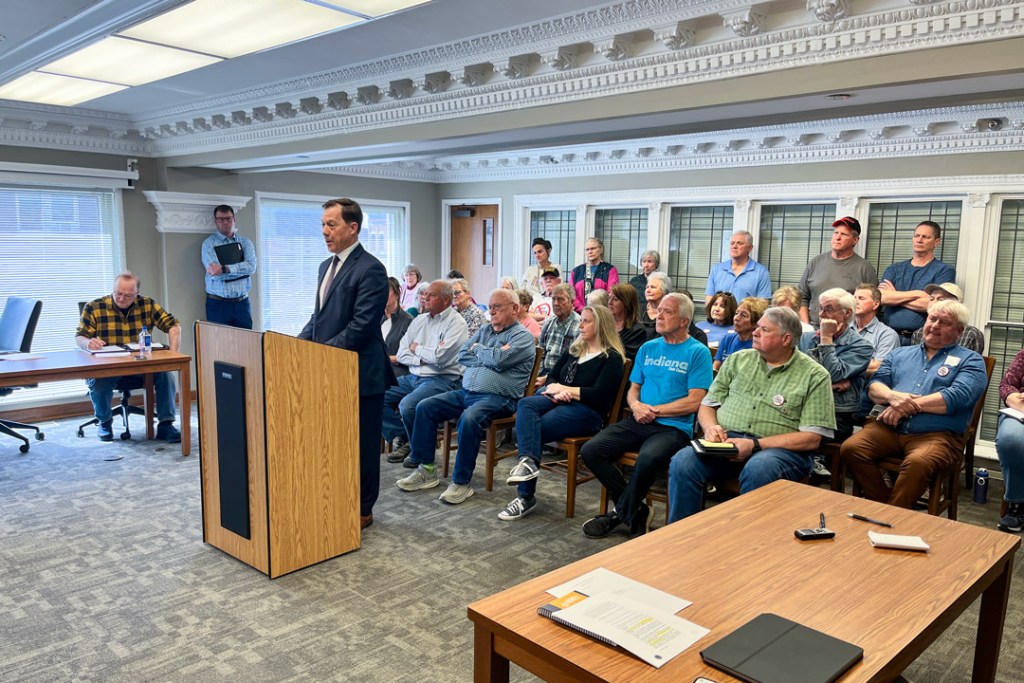
After a split commission stymied a vote on a resolution to continue to support the Mid-States Corridor Regional Development Authority, the Dubois County Commissioners voted to affirm the resolution in a special meeting held Friday afternoon.
Commissioner Serice Stenftenagel, who supported the resolution at Monday’s meeting, said she called the special meeting to question members of the RDA before officially considering the resolution.
Stenftenagel’s questions ranged from the rationale for the RDA’s continued existence in the Tier 2 study to the limitations on when the county could withdraw from the organization.
The RDA’s attorney, Bill Kaiser, and Chairman Mark Schroeder took turns fielding the questions. The pair maintained the RDA’s role in the Indiana Department of Transportation project as a direct representative for the county commissioners and council, as well as the other government units involved — Spencer County and the cities of Huntingburg and Jasper.
However, after the meeting, Commissioner Chad Blessinger echoed some of the public who spoke, saying that such an important and impactful project should fall to elected officials rather than an appointed board.
“I am not convinced they provide a value to the county,” Blessinger said. “I think that the work that they’re talking about is better done by the elected officials.”
Opponents of the Mid-States Corridor RDA argue that under the law establishing RDAs, it should have expired last year since its initial eight-year term had not been extended by the members.
Kaiser stated that the statute is unclear about what happens after that eight-year period if no action is taken. He also stated that, had Covid-19 not interrupted the Tier 1 study, the Tier 2 study would likely have been completed by now.
“We are asking the state government to write an opinion about this issue,” he told commissioners, while admitting the statute is vague.
He explained their understanding of the statute’s time length was to ensure members remained committed to completing the project it supported.
Stenftenagel asked whether, if they chose to remain a member of the RDA, the county could withdraw at a later time. Kaiser said he thought they could withdraw at any time, but he stated they have also asked for guidance on that question.
Stenftenagal also asked whether the county or the member entities could conduct an annual review of the funds the RDA is disbursing.
Kaiser explained that the RDA has stricter oversight on its funds than most governing bodies, likely because of its quasi-governmental formation as an appointed board. A state-designated accounting firm audits the RDA annually, and those audits are subsequently reviewed and approved by the State Board of Accounts.
Kaiser explained that all of the organization’s expenditures are public record and available online.
Stenftenagal asked if the Mid-States RDA would continue after the project moves forward with construction or is completed.
Kaiser said it would be determined by the member organizations whether the RDA continues.
“The RDA exists because you created the RDA,” Kaiser told commissioners.
Regarding the relinquishment of U.S. 231, Mid-States Corridor RDA Chair Mark Schroeder and Kaiser have maintained they are at the table representing the interests of the county and cities involved. According to Schroeder, they have made it clear that the county does not want to take over U.S. 231 if the corridor is built.
Huntingburg and Jasper have agreed to pay for a study of the road through their cities to determine how they will proceed with INDOT’s request to take over the highway. In Huntingburg, U.S. 231 is the city’s Main Street, and in Jasper, U.S. 231 constitutes portions of Newton Street and 6th Street.
Before voting on the issue, Blessinger pointed out that the question wasn’t whether commissioners supported the road; it was about the value the RDA continues to provide to the member organizations. “If there is no RDA, maybe that a little more something on our shoulders,” he said. “Maybe that’s the shoulder that should be on.”
Blessinger said he felt Schroeder, the commissioner’s appointment to the RDA, has done a good job of representing the county’s interests in his role on the board. “I’ve never thought that Mr. Schroeder had anything but good intention for the county,” he said before adding that 90 percent of the people on both sides of the issue have good intentions for the county.
He asked why the RDA is in a better position to speak on the county’s behalf with INDOT and the project managers.
“We are not more qualified than your county engineer, you as commissioners, the council, to do those things,” Schroeder said.
He explained that the county would just be burdened by those duties on top of running the county.
“Why would you not want as many voices advocating for what you want,” Schroeder asked.
Before making a motion to approve the resolution, Stenftenagal stated she felt the RDA was a good advocate for the county’s interests.
She outlined some concerns brought to her since Monday’s meeting, when she voiced her support for continuing the RDA. She stated she had been told she didn’t care about the future of the county or its next generations and didn’t have the backbone to make the right decision.
“I want those children to go to college, and I want them to come back here,” Stenftenagel said. “I think that is important.”
She then made a motion to pass the resolution. In response, members of the crowd voiced their dissent at not being heard before the decision, but the commissioners moved forward with the vote, with Commissioner Nick Hostetter seconding the motion.
Before doing so, Hostetter stated that for her to make a motion to support the resolution in a roomful of people who disagree with her “proves that you do have a backbone.”
It ultimately passed in a 2-to-1 vote, with Commissioner Chad Blessinger voting against.
The resolution affirms the commissioners’ recommendation of remaining a member of the RDA. The council will decide whether that occurs at its next regular meeting on March 30 at 4:30 p.m. While the council is the body that ultimately decides membership to the RDA, the commissioners appoint the county representative to the board.
Afterwards, the commissioners took comments from the crowd for about half an hour before convening. Among the comments were concerns that the RDA could be used to raise enough private funding to circumvent a budgetary review process that Senate Bill 27 created during this year’s legislative session. Under an amendment to the bill, any INDOT project with a budget exceeding $250 million in a single county must now go through a review process.
While elected officials can raise private funds for projects, the RDA simplifies the process by serving as a single entity representing multiple participating organizations.
The commission was criticized for not allowing input from public opponents of the project before making its decision. Blessinger stated that no one requested time on the agenda, a policy the commission has maintained throughout the process, but Mark Nowotarski, a member of the Stop the Mid-States Corridor Coalition, pointed out that the agenda was vague about what the commissioners would do during the meeting.
“It didn’t have Mark Schroeder or Bill Kaiser on here to speak,” Nowotarski said, adding that it only said there was going to be a discussion.
Blessinger acknowledged Nowotarski’s point.
Stenftenagal maintained that she had called the meeting to further clarify her thoughts and to have questions answered before making an official decision.
