
Dubois County Circuit Court Judge candidates Q&A
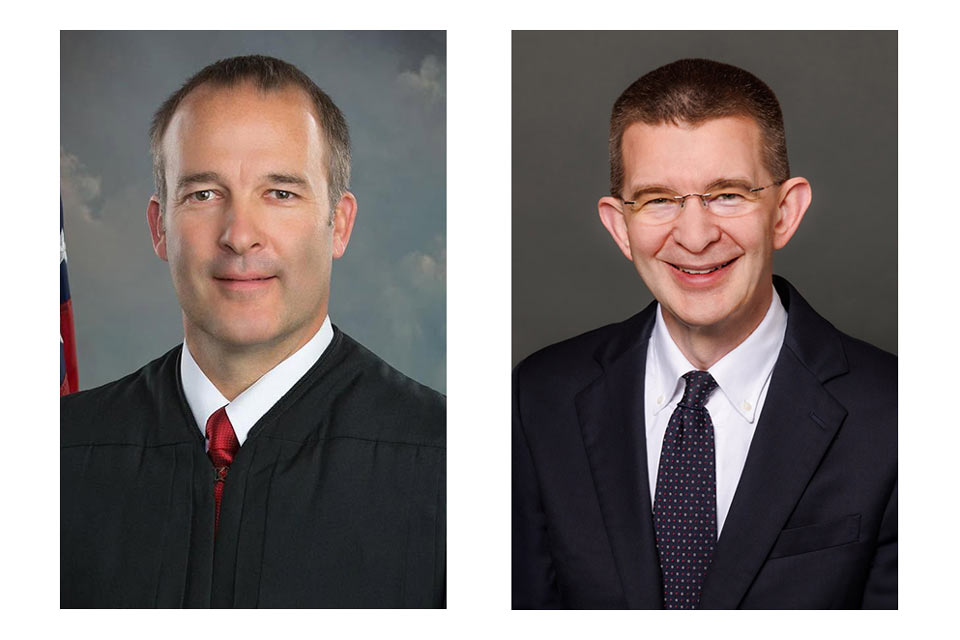
Dubois County voters will choose a Circuit Court judge in this year’s general election as Democratic incumbent Judge Nathan Verkamp faces Republican Brian Lucchi, a deputy prosecutor.
Here are the candidates’ announcements.
The Circuit Court judge is elected to a six-year term. Indiana’s circuit courts were first created by the state constitution, Article 7, Section 8. The court’s district, the 57th Judicial Circuit, has the same borders as Dubois County. That’s why most people call it the Dubois Circuit Court.
It is the county’s chief trial court. Dubois County’s two courts divide criminal cases by agreement. The Circuit Court handles homicide, kidnapping, robbery, burglary, battery, sex crimes, forgery, perjury, trespass, mischief, misconduct, weapons and violence charges, interference with governmental operations, crimes against public administration, and miscellaneous offenses under Article 46 of the criminal code.
Most other work is shared with Dubois Superior Court. Both courts hear civil lawsuits, divorce, paternity and child support enforcement. There are four exceptions. Traffic and small claims cases go only to Superior Court. Probate and juvenile cases go only to Circuit Court.
The Free Press asked both candidates the same nine questions. Their answers appear below as submitted, in alphabetical order by last name.
Question 1
Public Question 1 would let courts deny bail for offenses other than murder or treason if the proof is evident or presumption strong and the state shows by clear and convincing evidence that no release conditions would protect public safety. What is your position on Public Question 1, and why?
Brian Lucchi
If I am elected judge, I will look at each case individually and make decisions within the confines of the law – the law concerning bail or anything else – regardless of my personal opinions.
That being said, I support Public Question 1. I believe this proposed change to the Indiana Constitution is a recognition by our legislature that too many dangerous offenders have been released pre-trial by judges who fail to take into account the safety of our communities.
I am deeply committed to the safety of Dubois County, something that I’ve proven by my actions as a deputy prosecutor. If I am elected judge, my role in the courtroom will change. But one thing will not change – my commitment to protect our citizens from those who would do them harm.
Nathan Verkamp
[Editor’s note: Verkamp answered Questions 1 and 2 together. His answer appears under Question 2.
Question 2
What is the strongest argument on the other side of Public Question 1?
Brian Lucchi
The strongest argument against Public Question 1 is that it is not necessary. Indiana law already gives a judge the ability to set bond high enough to protect the community from dangerous offenders. In other words, a judge who has the will to safeguard the county’s residents doesn’t need the Constitution amended to do so. On the other hand, if a judge is looking for a reason to let defendants out of jail, changing the Constitution won’t stop that judge from doing so.
If I am elected judge, I will continue to take the safety of Dubois County seriously, regardless of what happens with Public Question 1.
Nathan Verkamp
Regarding this question and Question 2, I must refrain from providing a persuasive argument for or against Public Question 1. As the sitting Judge of the Dubois Circuit Court, the Indiana Code of Judicial Conduct prohibits me from taking a public position on this matter.
However to provide context, Article 1, Section 17 of the Indiana Constitution currently guarantees the right to bail for all individuals charged with a crime, with the exceptions of murder and treason. Public Question 1 proposes expanding the circumstances under which judges may deny bail. If approved, the amendment would allow courts to deny bail if the proof is evident or the presumption strong, and if the State of Indiana proves by clear and convincing evidence that no release conditions can reasonably protect the safety of another person or the community.
Proponents of the amendment emphasize the need for greater judicial flexibility to protect public safety.
Conversely, opponents argue that the proposal departs from the presumption of innocence and could contribute to jail overcrowding.
Question 3
Most courts have held that searching license-plate-reader (Flock) data without a warrant doesn’t violate the Fourth Amendment, but a federal judge in Oklahoma ruled this month that searching a month of historical Flock data did violate it (United States v. Kyle). When higher courts haven’t settled a surveillance question, what framework should a trial judge apply?
Brian Lucchi
Higher courts will always be forced to play catch up with technological developments. But while we wait for cases that deal specifically with new technology, we still have a framework for handling these questions.
When it comes to search and seizure issues in Indiana, in addition to Fourth Amendment protections, we are also protected by Article 1, Section 11 of the Indiana Constitution. Under Article 1, Section 11, a judge must decide whether a search/seizure is reasonable by balancing factors such as the degree of concern, suspicion, or knowledge that a violation has occurred; the degree of intrusion the method of the search or seizure imposes on the citizen’s ordinary activities; and the extent of law enforcement needs.
As the Indiana Supreme Court has said, “On the one hand, Hoosiers want to limit excessive intrusions by the State into their privacy. And so we liberally construe Article 1, Section 11 to protect individuals. On the other hand, Hoosiers are interested in supporting the State’s ability to provide safety, security, and protection from crime.”
As a judicial candidate, if I were to announce how I would rule in a specific future case, I could then be disqualified from handling such a case down the road. What I can say is that if I am elected judge, I will balance the above factors when it comes to searches whether those searches are high tech, low tech, or no tech.
Nathan Verkamp
Precedent is vital because it brings consistency, stability, and fairness to the legal system. Under the doctrine of stare decisis, courts follow past rulings in similar cases to ensure individuals are treated equally and can reasonably predict how the law will apply.
Even without a case directly on point, the court applies the same structured analysis to determine whether a constitutional violation occurred. First, the court acts as a finder of fact to determine whether an illegal search was conducted by the government. Then using those facts, the court evaluates the search and seizure under both Article I, Section 11 of the Indiana Constitution, which focuses on the totality of the circumstances and the reasonableness of the officer’s conduct, and also the Fourth Amendment to the United States Constitution, which relies heavily on a reasonable expectation of privacy and strict warrant requirements.
Question 4
Sentencing serves several purposes: punishment, deterrence, public safety, rehabilitation, and restitution to victims. Which carries the most weight for you, and why?
Brian Lucchi
This might be the single most important question for voters to consider when casting a vote for Circuit Court judge. And let me start by saying that if a judicial candidate says that any one of the above purposes is the most important consideration in every criminal case, that should be a huge red flag for voters.
I remember a defendant that I prosecuted years ago. She was young, made a poor choice, and some property was damaged. Was she a threat to public safety? No. I determined that not only did she not need to be punished, she didn’t even need a conviction. I required that she read some books to expand her thinking, write a reflection paper, and pay restitution to local businesses. And then I dismissed the case.
Contrast that with another defendant that I prosecuted. This man violated a child for years – stealing that child’s innocence, perpetrating on her in ways that the Free Press would not be comfortable publishing. What exactly is the dollar amount of restitution that would make that child whole again? And do these two defendants pose the same threat to public safety? I contrast them here to point out that every case is different and a judge must balance the above purposes based on the facts of the case at hand.
As I said when I announced my candidacy, I believe people can change. As a community, we ought to celebrate whenever that happens. When I was a deputy prosecutor in Dubois County, I often recommended probation or Community Corrections – possibly in the majority of cases. But let me be perfectly clear: I will not sacrifice the safety of our community at the cost of trying to fix every criminal defendant. Yes, a judge has a responsibility to be fair to defendants who choose to commit a crime. But a judge also has a duty to protect the citizens who are choosing to follow the law, working to pay their bills, and just trying to shuttle their kids back and forth from one after-school activity to another. If I am elected, I will not shirk from my duties.
Also – to be clear – I reject the notion that punishment is old-fashioned or unenlightened. What I heard over the years from Judge Verkamp is that the goal (singular) of the criminal justice system is rehabilitation. However, under Indiana law, certain crimes carry mandatory prison sentences, certain sentences can’t be suspended to probation, and certain crimes aren’t eligible for Community Corrections. The law has a place for punishment and I am not embarrassed to say that.
A judge has many tools from which to choose. Those tools include options such as probation, Community Corrections, and prison. As judge, when the law and the facts call for a defendant to be given a second chance and serve a sentence in our community, I will be happy to give the defendant that chance. But when the law and the facts call for prison, I assure you that I won’t be afraid to send a defendant there.
Nathan Verkamp
There is no single “most important” reason for sentencing. Instead, criminal justice system balances multiple core purposes: punishment, crime prevention, public safety, victim restitution, and rehabilitation.
Because every case presents unique facts and circumstances, courts must weigh and blend these competing goals in every sentencing decision. Judges need access to a full range of judicial options to address these goals effectively, rather than being restricted to a single approach.
Question 5
How do you weigh victim impact statements, and when is departing from the advisory sentence appropriate?
Brian Lucchi
A judge must protect the rights of criminal defendants; that’s a given. But victims have rights, too – and not in a squishy or sentimental way. Victims’ rights are actually built into our state’s constitution: victims have the right to be treated with “fairness, dignity, and respect.” Protecting those rights is the least that we can do for victims. After all, defendants choose to commit crimes; victims don’t choose to become part of the system.
As for weighing victim impact statements, I may sentence a defendant more leniently than what a victim requests or more severely than what a victim requests. But if I am elected judge, you can be sure that the voice of victims will be taken seriously in Circuit Court. Hearing from victims will be a priority for me.
As for departing from the advisory sentence, Indiana law gives factors for a judge to consider when deciding whether to go higher or lower than the advisory sentence – whether a person has a criminal history or has recently violated probation are two examples. But keep in mind that when the sentence is left up to the judge, the judge is deciding not only the length of the sentence, but also how the sentence will be served. Placing a defendant on home detention, for example, could be fitting in one case and outrageous in another. A judicial election is about choosing who you trust to get these decisions right.
Nathan Verkamp
Sentencing can be very nuanced and fact-sensitive. Every felony carries a prescribed minimum, maximum, and advisory sentence. The Court begins at the advisory sentence and may adjust it upward or downward based on statutory aggravating or mitigating circumstances.
The victim impact statement is particularly important because it can demonstrate that the harm, injury, or loss to the victim was greater than necessary to prove the elements of the crime, which serves as an aggravating circumstance. Based on these statements, the Court may decide to deviate from the advisory sentence.
Additionally, victim impact statements have led me to reject plea agreements when it was clear that the victim was not in agreement with the proposed plea terms.
Question 6
What have you personally done, as opposed to what would you do, to support programs that reduce re-offending or help victims?
Brian Lucchi
As I said above, as a deputy prosecutor, I have personally steered many, many defendants towards probation or Community Corrections to help them get back on the right path. Probation and Community Corrections have proved effective for countless defendants in reducing re-offending. But I have also done all I could to ensure that violent offenders, career criminals, and those who harm children end up in prison. When it comes to reducing re-offending, prison has a 100% success rate in this sense: during their prison stays, Dubois County defendants have perpetrated on zero Dubois County children, assaulted zero Dubois County females, burglarized zero Dubois County homes, and sold drugs to zero Dubois County residents.
As far as what I have done personally, outside of my job, to support programs that reduce re-offending, I am active in our church. Our church gatherings have included past and current participants in the criminal justice system – including defendants that I’ve previously prosecuted. Whether it’s while I’m teaching Sunday school or just while visiting before or after the church service, I do my best to make these individuals feel welcome. Not because I view them as some sort of project, but because I know that they need the same thing that I need; they need the grace of God. I can’t think of a better place for them (or me) to build a strong foundation for the future than church.
What have I personally done to help victims? There was a reason that the previous Dubois County Prosecutor, in an August 2020 press release, thanked me for my “tireless” work on behalf of Dubois County. I have poured out the last twelve years of my life prosecuting cases, mostly handling cases involving victims of crime. It was largely the experience of working with victims – many of them children – and seeing how a judge’s rulings affect real people that compelled me to run for Circuit Court Judge. It is my view that if we want to help victims, we should start by seeing that they receive justice. To that end, I have done my best.
Nathan Verkamp
We have worked together as a team to make Dubois County safer, more stable, and healthier. I will not claim to have done anything on my own, as we have a great group of people across many spectrums focused on meeting those goals. My role is to provide leadership, direction, and support.
To share two specific examples:
- Justice Partners Addiction Response (JPAR) Grant: As the supervisory judge for this grant, I help identify and support individuals involved in the criminal justice system who are experiencing substance abuse disorders and mental health conditions.
- Partnership with Crisis Connection: I have partnered with Crisis Connection to ensure domestic batterers receive appropriate abuse intervention services. Additionally, victims of abuse must complete the Choices Program to learn to identify the warning signs of abuse and have a safety plan in place for their family prior to the court rescinding a no-contact order.
Question 7
What is one change within a court’s authority that you think would reduce recidivism?
Brian Lucchi
If your co-workers break the rules and your boss continually responds by patting them on the back and encouraging them to do better (but never giving any consequences), you know what happens. The co-workers push the boundaries and the number of them who break the rules grows. That approach doesn’t work in the workplace and it doesn’t work in the criminal justice system.
If we want to reduce recidivism (i.e. re-offending), we must hold defendants accountable for their choices. If a judge defaults to leniency, defendants quickly catch on. The result is a revolving door that doesn’t help anybody. It doesn’t help the law-abiding community. And it doesn’t help defendants, who very well may want to do better, but won’t break the cycle if they are only slapped on the wrist.
Yes, some defendants need help with issues like substance abuse, mental health, and life skills. Our community is blessed to have various groups, organizations, and facilities that are devoted to recovery. Having those resources locally is a great thing and, as judge, I would take full advantage of them whenever appropriate. But the answer isn’t always another class, another program, or another counseling appointment.
While it would be foolish to believe that we can simply punish our way out of a mental illness or an addiction crisis, it is naïve to believe that treatment alone will necessarily be effective. At the end of the day, if there aren’t consequences (or the real possibility of consequences), we shouldn’t be surprised when defendants re-offend. I’m all for giving second chances where appropriate. But not endless chances.
Nathan Verkamp
In recent years, there has been a push for community corrections and probation departments to establish programs that reinforce positive behavior. Research demonstrates that positive reinforcement drives long-term compliance and behavioral change far more effectively than punishment alone.
However, the sentencing code has been slow to adopt this approach. To address this, courts should transition defendants between prison, jail, work release, home detention, and probation based on their progress in addressing individual criminogenic thinking.
Question 8
How do you balance “fair and impartial” in a bail decision when the decision can release a defendant who potentially reoffends or you detain a person who is presumed innocent?
Brian Lucchi
Yes, there is a presumption of innocence throughout a criminal case. And that’s a wonderful feature of our criminal justice system – a person can’t be convicted of a crime unless that person pleads guilty or is found guilty beyond a reasonable doubt. But it’s important to remember that when a judge is making a bail decision, the judge has already found probable cause that the person committed the crime. A defendant is not going to remain in jail unless a judge has decided that the defendant probably committed the offense. Period.
Also, Indiana law allows a defendant who is in jail to force the court to set an early trial date (often referred to as a “fast and speedy” trial), such that a defendant will not spend a lengthy time locked up awaiting trial unless the defendant chooses to do so.
So there are provisions in place to protect defendants. But Indiana law is clear that one of the purposes of bail is to ensure the safety of the community. We need judges who will look after not only the rights of defendants, but also the safety of the community. If I am elected, I will be such a judge.
Nathan Verkamp
Currently, Indiana Criminal Rule 2.6 governs pretrial release, directing courts to release an arrestee without money bail if they pose no substantial risk of flight or danger to the community—except in cases involving murder, treason, or individuals already under supervision.
We are fortunate in Dubois County to have a certified pretrial services program. Staff members meet with every person booked into the county jail on a new charge to complete an evidence-based risk assessment. They then compile a report for the Court, which provides vital information to ensure an informed decision.
Ultimately, our goal is to ensure that individuals are held in jail for the right reasons, rather than simply because they cannot afford bail.
Question 9
As Circuit Court Judge, you handle Juvenile/CHINS cases and work directly with the CASA program. What is the biggest unmet need for children in abuse and neglect cases in Dubois County?
Brian Lucchi
I have years of experience as a deputy prosecutor handling juvenile delinquent cases, but this question asks about children in abuse and neglect cases, so I will focus on those. Based on speaking with others who know more about CHINS (CHildren In Need of Services) cases than I currently do, my concern is that, too often, the process drags on too long, to the detriment of everyone involved. We can all understand how dragging the process out negatively affects the children. But I also don’t believe it’s compassionate to the parents. Within the confines of the law, I would like to see these cases resolved more quickly. For example, whether or not we achieve the goal of reunification, I would like to look for ways to reach the best decision in a more timely way.
I believe at least part of the solution is to insist on greater accountability from all parties involved. For example, we provide services and support to parents, but do we adequately insist that they take advantage of those resources? Likewise, we must insist that the Department of Child Services (DCS) be held accountable for its part in the process.
I am thankful for the CASA (Court Appointed Special Advocates) program. I can assure those who have stepped up to serve in that capacity that, if I am judge, they will be heard by me.
Finally, when you ask about the biggest unmet need for children in “abuse and neglect cases,” I don’t think only of CHINS cases. I also think of criminal cases.
I believe that we should care for all children who find themselves in Dubois Circuit Court, not only those who are lucky enough to be appointed a CASA. It is good and right that we pour resources into the child whose parents are, for example, struggling to parent due to substance abuse. But what about the child who has been molested by a criminal defendant? We must not care for one child more than the other. Kids in criminal cases are worth saving, too. This plays itself out in various ways, but it starts by treating these child victims with fairness, dignity, and respect. If I am elected judge, they will be.
Nathan Verkamp
In Children in Need of Services (CHINS) cases, we frequently struggle to find foster families nearby. This issue is compounded by a shortage of service providers available to supervise parenting time, forcing children to spend hours in transit for brief visits with their parents.
In juvenile delinquency cases, the shortage is equally severe. We currently have children in residential placements five hours away, and there have been times when we could not secure a single secure bed anywhere in the state for a juvenile who needed to be detained for safety reasons.
While our ultimate goal in these cases is always family reunification, the lack of local foster homes and services makes this process difficult. Fortunately, the Department of Child Services and Juvenile Probation have stepped up significantly to help fill these gaps.
