
Data centers discussions highlight pros and cons
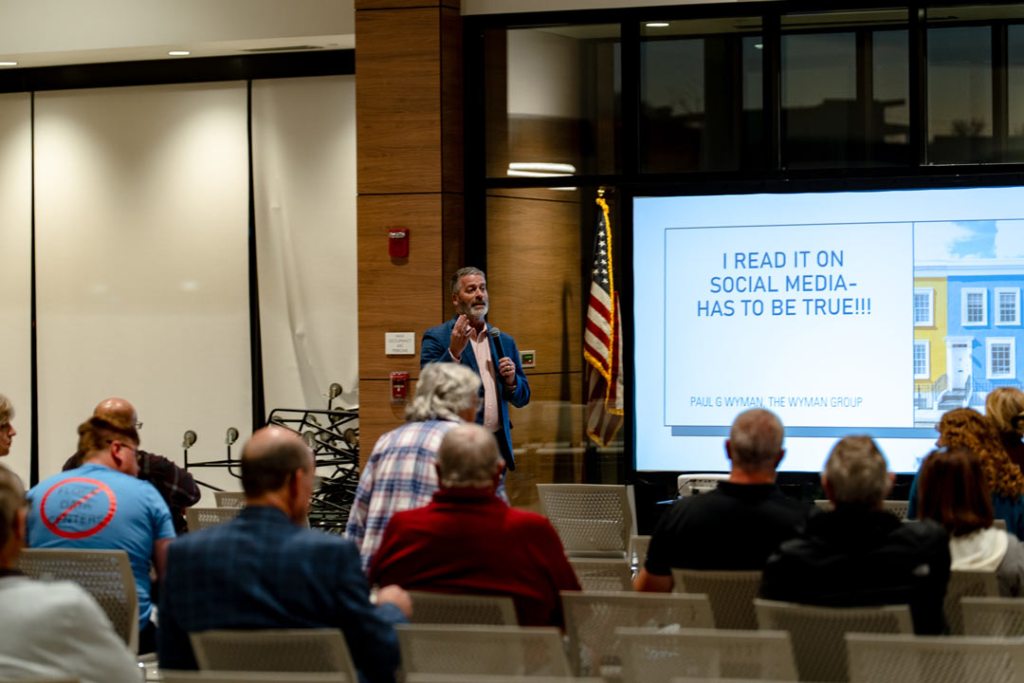
Paul Wyman told a crowd in Jasper he wasn’t there to sell them on data centers at a seminar hosted by the Jasper Chamber of Commerce on Tuesday. But he left no doubt about where he thinks the technology is headed.
“This doesn’t go backwards from here,” Wyman said. “It only goes forward from here.”
Wyman, owner of The Wyman Group, a Kokomo real estate company, was invited to Jasper to give a presentation on data centers after Mayor Ryan Craig heard him speak at a real estate conference in Indianapolis on wind, solar, battery energy storage systems and data centers. Craig reached out to the Jasper Chamber to help facilitate the event.
Craig told the nearly 45 people in attendance at Tuesday’s informational session he pushed for the seminar because he wanted the public to hear the same information he and the City Council are hearing.
“As I’ve said from the beginning, no one’s knocking down our door … to come to Jasper, Indiana, to build a data center,” Craig said. “But the time could come where we do have those questions. So you all hear the same information that myself and our council is hearing. We aren’t meeting behind closed doors and having private conversations with anyone.”
Wyman told the crowd his real estate company is marking its 25th year. He previously spent 16 years in county government: four on the county council and 12 as a county commissioner in Howard County. He said he is currently working on the zoning and annexation side of a data center project in Kokomo and Howard County, which grew out of a 700-acre industrial park he helped get zoned and annexed after the Kokomo area’s last industrial land went to an EV battery plant.
Wyman started with the basics. “A data center houses the internet,” he said. Any time people hear “the cloud,” he said, they’re hearing about a data center: a giant warehouse full of computer servers, with heavy power and cooling. Streaming movies, phone apps, photos, text messages, online shopping, banking, medical records and video games all run through one, he said.
Businesses relied on data centers long before the internet reached most homes. Bank of America began running its checking accounts on a General Electric computer system called ERMA in 1959, and by 1966 twelve regional ERMA centers served nearly all of its branches. Hospitals made the switch later, but quickly: federal data shows 9% of acute care hospitals used electronic health records in 2008, compared with 96% by 2015. For most of that history, companies kept their computers in their own buildings. In 2010, smaller traditional data centers held 79% of the world’s computing workloads, according to research published in the journal Science. By 2018, 89% had moved to cloud data centers, the large shared facilities now at the center of the debate.
The demand behind data center growth, Wyman argued, comes from ordinary users. “All of us in this room are creating the demand,” he said. He cited 5 billion cellphone users, 4 billion people on social media and an average of seven hours a day spent online.
Industry analysts describe the recent buildout differently. “For the last few years, AI infrastructure demand was largely driven by model providers training the large foundation models,” Hardeep Singh, a senior principal analyst at the research firm Gartner, told the trade publication CIO Dive.
Wyman also cited a projection that energy demand will be 50% higher by 2050. Meeting it, he said, will take every source available: solar, wind, gas, oil and coal. “It means all hands on deck,” Wyman said.
Federal projections suggest data centers themselves will be a growing share of that demand. In a May 2026 analysis of its Annual Energy Outlook, the U.S. Energy Information Administration projected that computer servers, which used about 7% of the electricity consumed by commercial buildings in 2025, will use 22% to 33% by 2050. The high end of that range assumes servers don’t become more efficient and that AI servers make up a larger share of the total. EIA projected server electricity use will reach 446 billion to 818 billion kilowatt-hours a year by 2050, with standalone data centers accounting for more of that growth than all other server rooms combined.
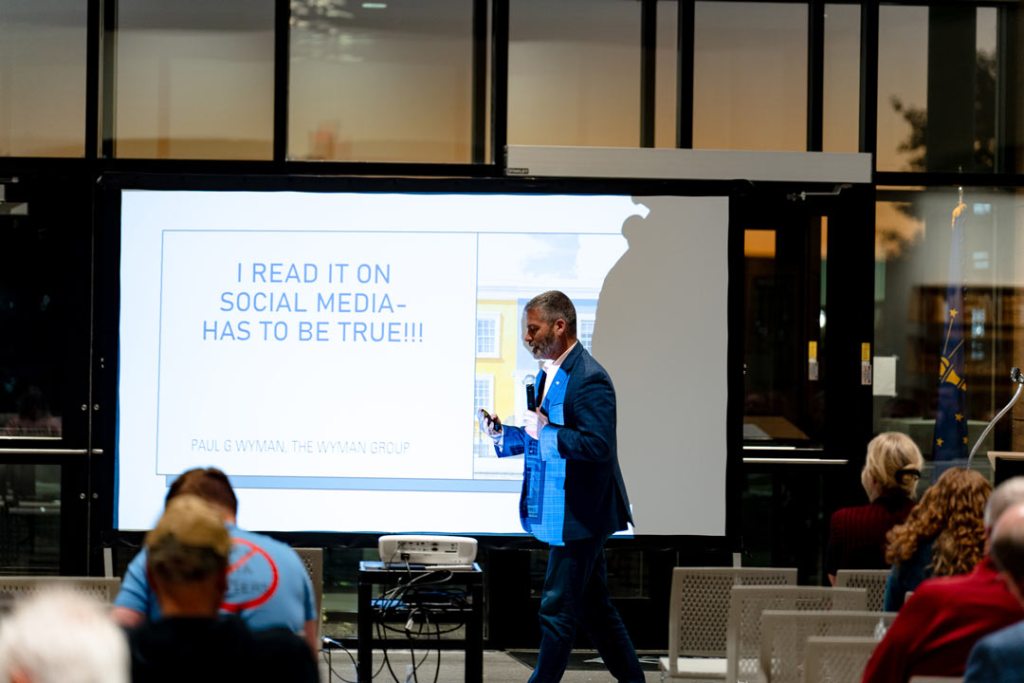
Much of Wyman’s talk covered his own look into the data center debate. He said that journey began after he heard concerns about data centers at public meetings on the industrial park rezoning, even though no data center had been proposed. He said he and his son then flew to Loudoun County, Virginia, which he called the data center capital of the world. He said the county located near Washington, D.C., has 230 data centers.
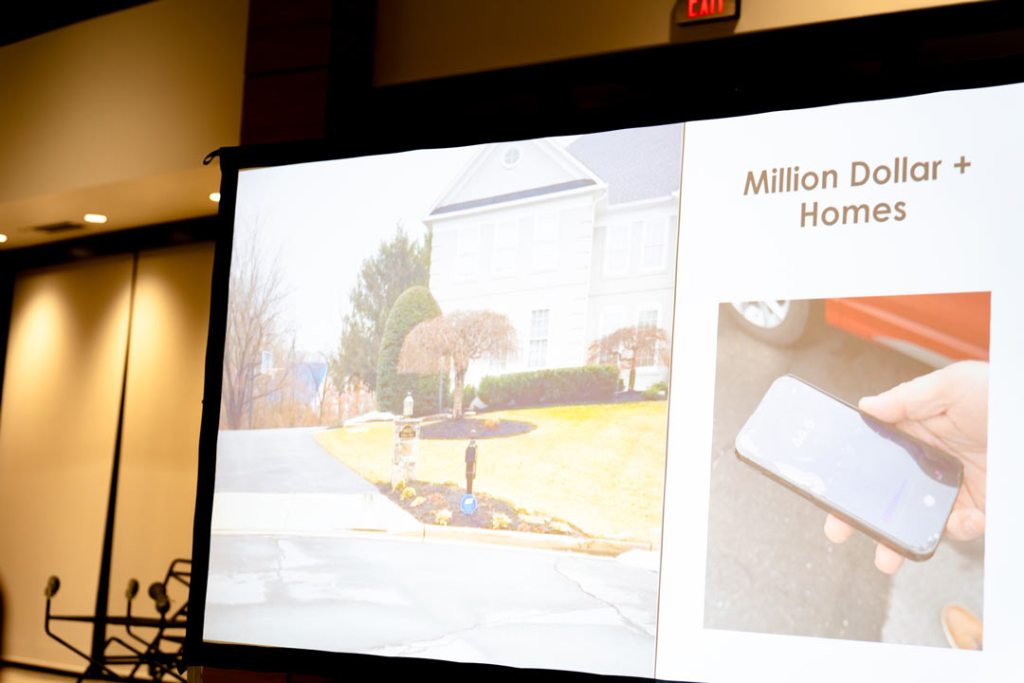
Wyman said he took a decibel reader to data center property lines and nearby neighborhoods. For comparison, he said the Thyen-Clark Cultural Center atrium registered about 60 decibels as he spoke, mostly from the air conditioning. He said most readings at the property lines were around 50 to 55 decibels. In one neighborhood across the street from a data center, the reading was 44.6.
While he was in that neighborhood, Wyman said, a man walking his dog with his wife told him the data center had “been good neighbors.” About three-quarters of a mile down the road, Wyman said, he found another facility where there was “zero effort, like zero” on landscaping and buffers.
That gap between good and bad operators was the core of his message.
“There are some data centers that are incredibly good neighbors, and there are some data centers that are not so good neighbors,” Wyman told the crowd. He urged cities to set their own terms before any company comes calling, and to use them to screen out the bad ones.
Questions to ask included: Can the company meet the city’s sound limit at the property line? Will it use a closed-loop cooling system, which refills rarely, rather than an evaporative one, which draws water daily? He said companies choose evaporative because it’s cheaper. Will it pay the full cost of utility upgrades and the power it uses, and sign a federal ratepayer protection pledge? If a company won’t sign, he said, “Your first question should be why.”
“You’ll quickly realize the ones that may not be right for your community based on the conversations that you have with them,” Wyman said.
After the presentation, Wyman answered written questions from the audience. Wyman, whose background is in real estate and county government, answered questions on public health, national security and the future of AI largely from personal experience and conversations. He did not cite studies or data in those answers.
The first asked whether elected officials should ever sign nondisclosure agreements, which can bar officials from discussing a project while it is being negotiated.
Wyman said he would not tell an elected official never to sign one, but that “the majority of times they don’t have to.”
“You can do big projects, solar, wind, data, without signing NDAs,” he said.
He also said officials need some room to negotiate privately. “If they don’t sign an NDA, they can’t be on the front page of the newspaper every day talking about every single detail that is being negotiated,” Wyman said. “… the minute that happens, companies stop calling.”
Wyman pointed to Kokomo, where he said the mayor wrote a newspaper op-ed laying out the city’s terms once a data center project became real: no tax abatement, and the company pays its own way on utilities.
He said few mayors hold open sessions like Jasper’s. “He’s probably not going to have to be in a position to sign it because he’s having a conversation with you all,” Wyman said of Craig.
One attendee asked why the community should “sacrifice the environment and public health” so companies can make more profit, noting the area already has pollution concerns.
“No investment should ever environmentally harm you. I don’t care what the investment is,” Wyman said. He said that is why communities need to press companies on water and power before agreeing to anything.
He also said that environmental issues from electrical production are a different conversation and went so far as to congratulate the community for the solar power developments in the southern portion of the county.
“I’m all for sitting down with you and saying, let’s talk about how in 2050 we meet that power demand in a better, cleaner way,” he said. “(We) should have that conversation. It should not prevent you from saying a data center could be right for our community for 25 other reasons that benefit us, and at the same time, how do we deliver a cleaner power?”
Asked whether data centers should take priority over residents during an energy crisis, Wyman said well-run operators can ease strain on the grid by switching to on-site backup generators or battery storage during peak demand. If a company can’t or won’t do that, he said, a community should ask, “Is this really the right company for us?”
Wyman’s presentation pointed out the positive aspects of data center usage, including supporting the consumer demand for entertainment like movie and music streaming and video gaming, online shopping, and bill paying or banking. He didn’t discuss the collection of personal data by social media companies or images collected by security devices like traffic and doorbell cameras.
When questioned about those aspects of data center usage, Wyman deferred to the overall impact of the demand for online services driving the growth. He explained that if we pick a hot topic like Flock cameras as a stopping point for data center usage, we are ignoring the “99.999% of other things done in a data center have nothing to do with Flock.”
After the seminar, several residents in attendance stated they were disappointed in the presentation’s pro-data center approach.
Ferdinand resident Rock Emmert, who helped organize the “How Data Centers Affect Communities” forum held at the Astra Theatre on Nov. 9, said Wyman’s presentation did a good job of advocating for community leaders to ensure the best outcome for their communities if approached by a data center company.
But he was disappointed that Wyman did not address the impact these centers have on the environment and public health.
“That was my biggest concern about the presentation,” Emmert said. “Absolutely zero concern for public health and pollution.”
During the Nov. 9 forum at the Astra, Bryce Gustafson from Citizens Action Coalition (CAC), discussed the less attractive aspects of data centers including higher utility rates, constant noise, increased air pollution, and other impacts on communities.
Emmert said he would like to see city officials bring in individuals like Gustafson, scientists or medical professionals to provide information on the adverse impacts of data centers.
Wyman himself made a similar point at the start of the evening. “There’ll be more of these (seminars), and there should be,” he said. “And you should have all kinds of speakers come in and talk to your community.”
Craig said Tuesday’s seminar was just the beginning of conversations on this topic and that Wyman’s presentation helped city leaders understand what are and prepare “the hard questions to ask.”
He again affirmed that no company is approaching the city. “There’s nothing on the docket, nothing on the radar,” Craig said. “But if one comes, I think we should be prepared.”
He added that he attended the Nov. 9 seminar with the CAC and said those conversations need to be heard too.
“I want this to be open for conversation,” he said, “and that’s the only way we end up with a good result.”
