
Countywide zoning meeting turns into public input session on solar projects

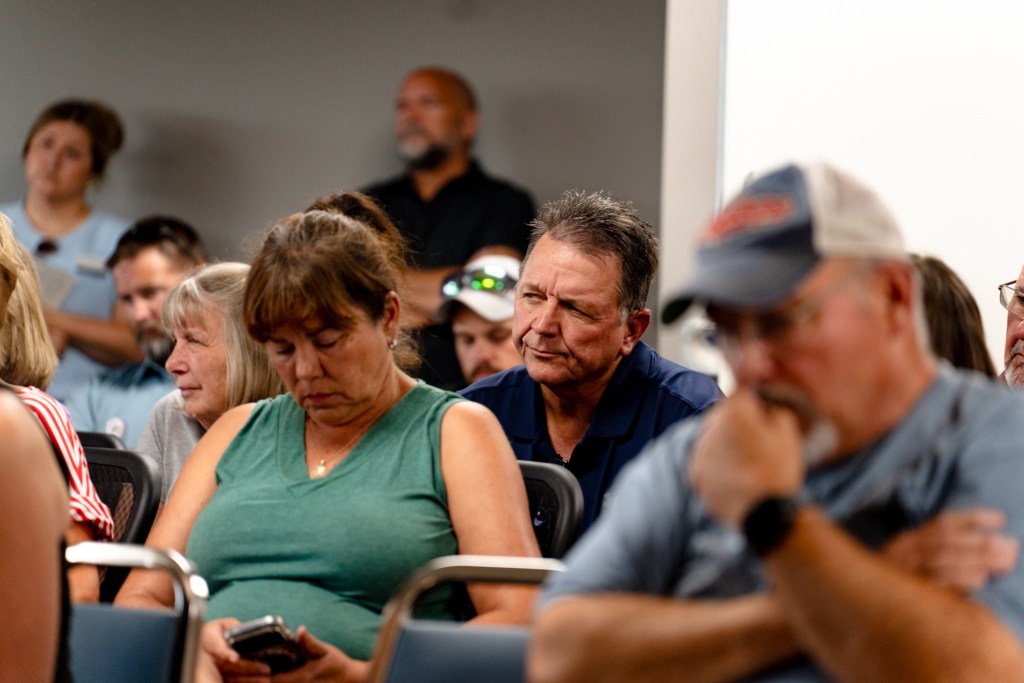
Jasper — Dubois County Commissioners hosted a public forum on Tuesday to help determine how to address developing countywide zoning, but the nearly 80 Dubois County residents attending spent most of the time pressing commissioners for tighter control over solar and battery storage development.
The forum, held at the Dubois County Health Department, was the first of two sessions commissioners scheduled to gather public input ahead of a solar development moratorium set to expire in December. Commissioners are in the midst of comprehensive planning and have repeatedly leaned on the lack of zoning as an issue when it comes to regulating these and other types of installations and projects.
At Tuesday’s meeting, Commissioners Blessinger, Serice Stenftenagel and Nick Hostetter provided some clarification on issues brought up but largely allowed anyone to speak for as long as they wanted while they took notes.
Several speakers focused on road safety tied to construction traffic for the Crossvine solar and battery storage project south of Huntingburg.
Cheyenne Temple, who drops her daughter off at Hummingbird Daycare each morning, described multiple near-collisions involving semis hauling battery units without escorts, including one that ran a stop sign as a dump truck approached. With roughly 2,000 children living within a 3.4-mile radius of the Crossvine site, Temple said, “I’m concerned about the kids.”
Charlotte Conlin, who commutes daily through the construction area, said she now avoids the roads when possible. “I no longer feel safe driving them,” she said.
Jacey Lamb read a prepared statement arguing that no single state agency has jurisdiction over battery storage systems sited in the 100-year floodplain, since the Indiana Department of Homeland Security’s elevation standard only applies to systems it approves, while the Department of Natural Resources, and the Indiana Department of Environmental Management claim partial authority, while the Dubois County Soil and Water Conservation District, which could fill the gap, has none.
Editor’s note: A previous version of this story described DNR, IDEM and the Dubois County Soil and Water Conservation District as each holding partial jurisdiction over BESS siting in floodplains. Lamb’s remarks at the forum drew a sharper distinction: while DNR and IDEM hold defined, if limited, authority (floodway permits and stormwater/wetland review, respectively), she said the SWCD holds none, because it does not participate with IDEM and therefore has no IDEM-granted authority at all. In a subsequent interview, the local SWCD confirmed that Soil and Water Conservation Districts have no regulatory authority but, if staffed with a qualified individual, will provide technical oversight and report findings to IDEM, which is the regulatory agency.
She pointed out that the lack of zoning is an issue.
“Because Dubois County has no zoning authority whatsoever, and there is no local body to impose site-specific restrictions or conduct the holistic review that flood-prone development demands, there is no line of defense,” she said. “IDEM (Indiana Department of Environmental Management) accepts the SWP3 (Storm Water Pollution Prevention Plan) that the developer provides, whether our county or community agree with it or not. This is not a minor administrative detail; it is a failure with government that leaves residents exposed to catastrophic risk.”
Lamb proposed a “Community Energy Review Board” made up of two residents per township — one from an incorporated town, one from an unincorporated area — to require developers to present safety and flood-risk data in public hearings.
The comment prompted a tense exchange when another attendee objected to Tom LoTurco, Executive Vice President East, Canada & Government Affairs for EDP Renewables — which is developing the Duff Solar Park — being allowed to speak, arguing only county taxpayers should have a voice.
LoTurco noted that EDP Renewables would be paying property taxes on the Duff Solar Park before commissioners intervened to let LoTurco respond.
He said state lawmakers had since passed Indiana Code 22-14-8-8, which he said requires battery storage systems to be sited within a half-mile of a 100-year floodplain must be two feet above the 100-year floodplain elevation.
Lamb countered that the local site operated by AES, which did not have a representative at the meeting, sits roughly 30 yards inside the floodplain without the required elevation, and said Indiana Department of Homeland Security officials had been notified.
Correction: Originally, the previous paragraph stated IDHS had confirmed the issue; this misrepresented what Mrs. Lamb stated. She simply said she had talked to them about the issue regarding the floodplain and elevation.
In an email exchange shared with the Free Press on Thursday, LoTurco stated that in the drawings he has been shown, AES is complying with the state code.
Several speakers, including Barb Hopf, submitted detailed proposed changes to the county’s existing solar ordinance. Hope’s list included increasing the current 250-foot solar setback to 1,500 feet from neighboring property lines and 2,000 feet from subdivisions, requiring mandatory tree lines or fencing along property lines, barring battery storage within a mile and a half of LP gas tanks, and prohibiting solar and battery projects from using road right-of-way as a “utility” if the power isn’t serving local customers. Hope also asked commissioners to require decommissioning funds be in place at groundbreaking rather than years into a project’s life.
Dave Duncan read from the county’s existing solar ordinance, which was adopted directly from the state law, arguing that a provision allowing the county to waive or loosen its own setback standards undercuts any real protection. “There shouldn’t be no waivers in any kind of zoning,” Duncan said.
Blessinger acknowledged the state’s solar ordinance allows the county to waive its own standards, but said the alternative at the time it was adopted was no regulation at all.
“I think what happened was we had no zoning. They gave us an opportunity to put in some mild zoning here, so we put it in, and I think I agree with you and most of the people in the room probably that we can do better than this,” Blessinger said.
In one of the few comments that directly addressed zoning in Dubois County, Holland Councilman John Kaltenbacher told commissioners it’s time for the county to adopt what he called “common sense zoning. Not to restrict what residents can do on their own property, he said, but to give the county real leverage over incoming industrial projects. “We want to see this directed towards these industries that are coming in and being more proactive to keep these industries in check,” Kaltenbacher told commissioners.
Jared Harris told commissioners he had been informed by an industry contact he had that battery storage systems at the site are not physically connected to the solar array, and instead draw power from the grid to resell at a profit. “The solar field is like a cover to trick people into thinking it has to be there,” Harris said, asking Crossvine representatives — who he said have never attended a public meeting — to demonstrate otherwise. Harris also asked commissioners whether they had signed non-disclosure agreements with any solar or energy companies.
All three said they had not been asked to sign non-disclosure agreements.
The forum also surfaced a legal tension commissioners said limits how far they can go without adopting formal zoning.
Resident Holly Bartelt Gogel stated the county should be able to control these installations by enacting ordinances.
“The county has ordinances. They enacted multiple ordinances last night at the county council (meeting). You guys have signed a ton of ordinances. You have an existing solar ordinance. Why can’t we make more?,” she asked. “Let’s strengthen it.”
She added later in her comments that “if the legal structure doesn’t allow us to have ordinances, then yeah, I think zoning, common sense zoning, is the direction to go.”
In response, Commissioner Hostetter stated that his understanding was that stacking up too many individual ordinances — on solar, battery storage, data centers and the like — could effectively push the county into zoning territory without ever voting on it. “If we do too many ordinances, we push the envelope too close to zoning, and then the state can come essentially force us into zoning,” Hostetter told the crowd.
Blessinger agreed, saying the county’s attorney has already warned that adding further ordinances risks “skirting the law.” However, he noted that outcome isn’t necessarily a bad thing if the county is prepared to move toward zoning anyway.
Blessinger, in a brief interview after the forum, said he was glad residents had a chance to speak but had hoped for broader turnout from across the county rather than largely from areas closest to existing projects. “Ideally, I’d like to know what does zoning in Dubois County mean to a person that lives in Dubois, not just a person that lives in Holland or Duff,” he said.
Blessinger said the county’s options are currently limited to accepting or rejecting projects that meet the existing ordinance’s standards, since without zoning, the county cannot regulate a company’s internal operations or deny an otherwise-compliant road use or permitting request.
He said commissioners are exploring whether an extension to the December moratorium deadline is available if the county shows a good-faith effort toward zoning, but does not want to wait until the deadline nears to start the process.
A second public session, focused on the county’s broader comprehensive plan, is scheduled for Aug. 5 at the Thyen-Clark Cultural Center in Jasper.
