
Community continues to voice concerns on expansive solar projects

Residents continued to bring their concerns regarding solar projects to the Dubois County Commissioners, though the commissioners have maintained they have little power to stop the projects currently under construction.
At Monday’s regular meeting, residents asked commissioners about the second phase of EDP Renewables Duff Solar Project, fire safety, road closures and a lack of independent county oversight.
Barb Hopf, speaking on behalf of neighbors who said they were reluctant to appear publicly, asked commissioners directly what benefit solar parks provide to Dubois County as a whole.
Commissioner Chad Blessinger said it was not his position to declare the projects good or bad, noting the solar parks had met all legal requirements to operate in the community.
“Something being legally permissible versus us being supportive of it are two different things,” he said. “In this case, the solar parks have met all the requirements to be a legal business in the community.”
Commissioner Nick Hostetter said the state won’t allow the county to ban solar power, and he acknowledged that the solar is going onto private property.
“We can’t tell them what they can’t do and can do,” Commissioner Serice Stenftenagel added.
The county has maintained that it would need zoning ordinances to better regulate these types of installations. It is working on a comprehensive plan that includes developing zoning ordinances for the county.
Hopf pushed back, explaining that the commissioners regulate land through subdivision ordinances that preclude her from giving family members portions of land less than 10 acres without creating a subdivision. “I can’t give a family member or anyone an acre of land, two acres of land…I have to give them 10 acres of land, otherwise I have to make that a subdivision,” she said. “So, you have told me that I can’t do something that I want to do with my land.”
The land being used by solar power companies is being leased, though.
She told the county they should be able to add more restrictions on solar parks and should review the ordinances to protect adjacent landowners.
“I think you are absolutely right,” Blessinger told her.
Hostetter agreed as well, but added that they can’t be so restrictive that they create barriers to development. Hopf pointed out that Daviess County had established 2,500-foot setbacks from adjacent properties for solar projects, as an example. Dubois County has 250-foot setbacks.
Hostetter said they could potentially be more restrictive in their setbacks, but the 2,500-foot setback would likely not survive a legal challenge because it is too restrictive.
“What we did was we adopted the state standard, and at the time it seemed like the right thing to do,” Hostetter said. “Well, of course things change; we see how it affects people. We can’t necessarily change anything with current, but we can fix that going forward.”
He told her they appreciate the input.
With the costly damages and scarring to public and private land left by the White Stallion Shamrock Coal Mine north of Ireland looming in the background, Hopf asked about how the bonds protect the county from costly repairs and future issues if the companies declare bankruptcy or go out of business.
Blessinger said the county has learned its lesson from White Stallion and been more diligent in monitoring and negotiating adequate bond amounts for potential issues.
Hopf further questioned how a solar company would have the right to enter private property without permission. She said they have been told by the company’s contractors that they are allowed to come onto their property since they are a utility.
Blessinger said they have access to private property through public rights-of-way on private property.
Hopf then pointed out that because of the county’s subdivision ordinance, she had larger rights-of-way that the solar companies were using.
“You’re telling me the solar company can go in there because I was mandated to do something on my property I didn’t want to do,” she told Blessinger.
He said that those regulations would only become more intrusive if the county established zoning.
“But zoning would have stopped the solar panels from being so close to someone,” Hopf said.
Blessinger reminded her that, when it was first proposed years ago, the public was opposed to any county zoning. “It was stopped because the public didn’t want it,” he said.
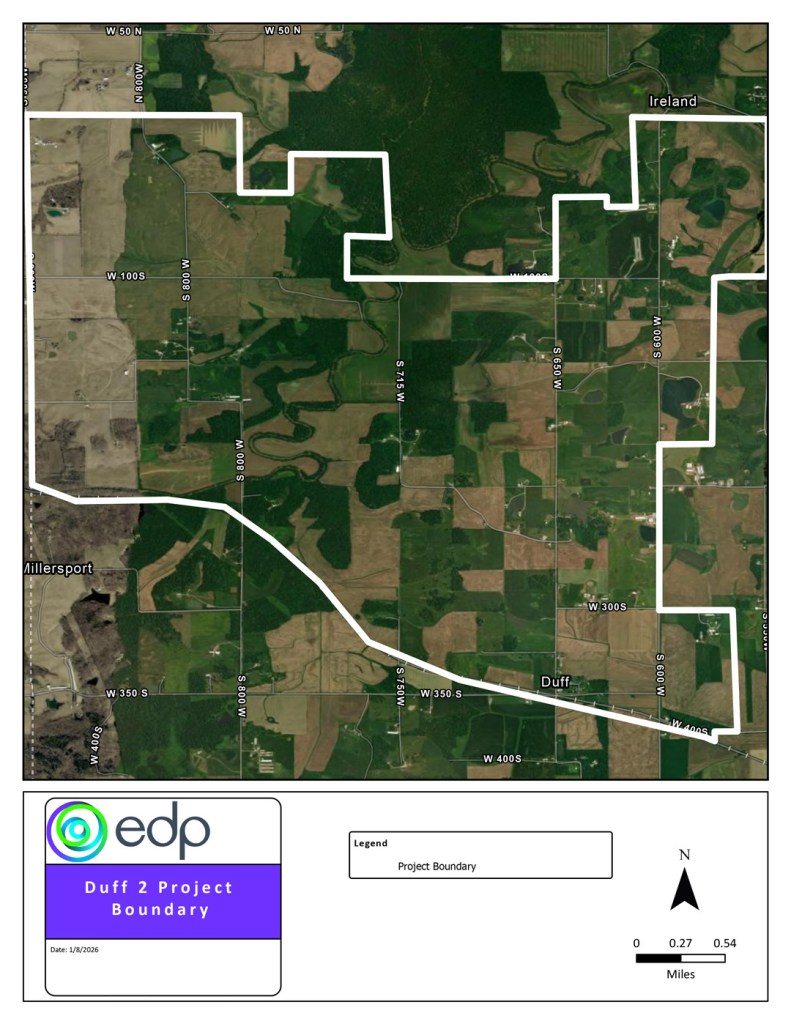
Hopf asked how they could stop the second phase of the EDP Renewables development.
The company has stated that it is seeking to expand solar panels north of the railroad crossing up to Division Road and is actively acquiring leases from landowners to support that expansion. However, the county has imposed a moratorium and told the company that it was not ready to permit the second phase of the project while that moratorium was in place.
Blessinger said they could extend that moratorium as they make determinations regarding future land-use ordinances.
“I don’t have a big appetite for it,” he told Hopf.
He also told her that they would likely agree on far more than they disagree regarding the solar projects.
“When we first were looking at this and the solar companies were coming in, I didn’t think there would be an issue,” he said. “I didn’t know it was going to turn into the monster that it did. If people want to be mad at me for that, I’ll take full responsibility for that. We’ve never done it before, right?”
But he also pointed out that they had limited legal authority to stop a property owner from allowing a lawful use of their property.
“If Mr. Smith has 100 acres and he wants to make money leasing it to somebody, we didn’t have any legal authority to get in the way of that if we wanted to,” Blessinger said.
In hindsight, Blessinger said he wished the companies would have never come to Dubois County.
During public comment, several residents addressed the commissioners regarding issues with the AES Crossvine Solar project.
Dave Duncan shared findings from a retired power company vice president he had consulted about a plume study submitted by AES. The individual told Duncan that the study “appeared to be a sincere effort at trying to quantify something that is difficult to pin down, but I seriously disagree with a couple points.”
The expert said the study used parameters unsuitable for determining community impact and took issue with the evacuation threshold it cited. The study used AEGL-2 — acute exposure guideline limits — as the trigger for evacuation, a standard the expert said was too high. At AEGL-2 concentrations, he said, some people would already be too sick to evacuate on their own. He argued AEGL-1, which represents lower gas concentrations, should be the threshold instead.
The county emergency management director has asked for another plume study to be conducted using more extreme wind speed parameters.
Resident Jacey Lamb also raised a separate but related oversight concern, telling commissioners that the county’s own response to her public records request revealed it had not conducted any independent technical, engineering or regulatory review of materials submitted by AES for the Crossline project.
She quoted the county’s response directly: “Aside from the initial permit application, road cut or right of way permit application, and driveway permit applications, the county did not conduct independent technical, engineering, or regulatory review of these materials, nor did receipt of such documents constitute approval enforcement or acceptance by the county. Additionally, the county did not issue permits or authorizations based solely on these materials, and no determination should be inferred regarding compliance through applicant laws, ordinance, or regulatory requirements.”
“The statement makes the basis for approving this project extremely unclear,” Lamb said. “If the county did not conduct any independent review, then on what basis was the project allowed to proceed?”
She said the county appeared to have relied entirely on the developer’s own submissions without independent verification of safety, compliance or community suitability. She also noted that several categories of records required under her request were not provided.
The commissioners did not address Lamb’s statements directly during the meeting, but when her three-minute timer ended her comment period, they invited her to request a place on the agenda at a future meeting to discuss these findings more thoroughly.
