
Commissioners report on meeting with AES, Battery Energy Storage System plume study results
The Dubois County Commissioners discussed emergency response planning for the AES battery energy storage system to address concerns raised by residents and local community leaders.
Those concerns are largely based on the BESS’s proximity to Southwest Dubois County Schools, daycares and communities that may be affected if the system were to catch on fire. AES and Fluence, the manufacturer of the BESS, have attempted to assuage those fears with statements regarding the testing and upgrades the system has undergone, as well as the safety systems in place to address internal issues if they arise.
Commissioner Chad Blessinger reported that AES met with Dubois County Emergency Management and Huntingburg Fire Department on the continued development of the system. During that meeting, AES stated the project will be substantially completed by June of 2027.
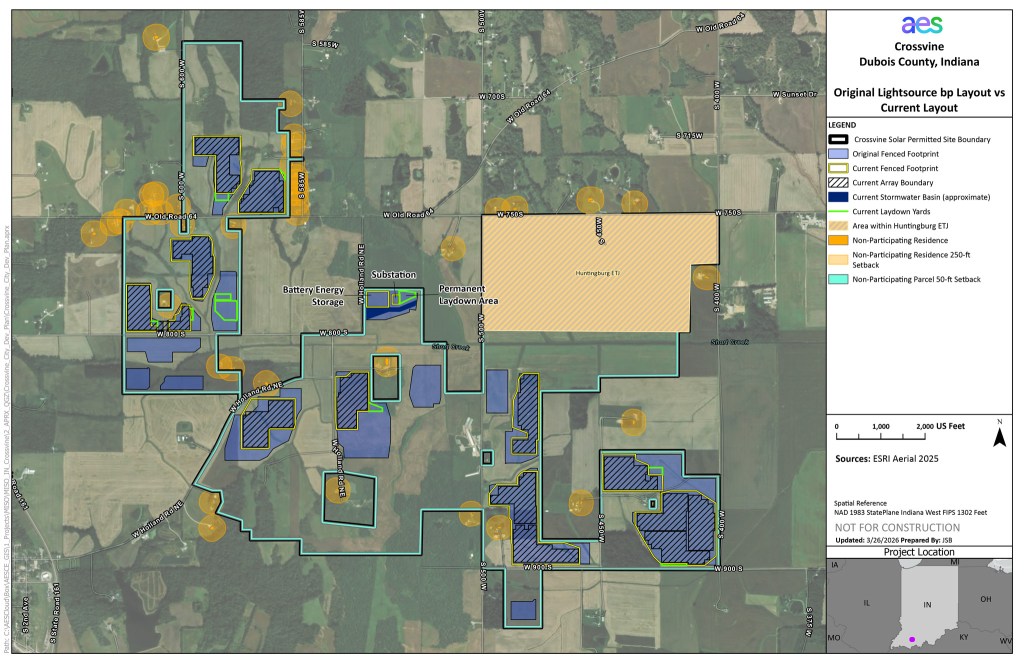
When complete, the battery storage facility and the solar panels will be installed on 400 fenced acres, though the total area under lease extends significantly beyond that perimeter.
A key component of the safety planning involves an independent plume study commissioned by AES but conducted by a third-party company. The study examined worst-case scenario events to determine potential impacts on surrounding areas, Blessinger said.
The study’s findings provide reassurance about containment capabilities. According to AES, the results indicate that even in worst-case scenarios involving battery fires, harmful emissions would not extend beyond the facility’s property boundaries.
“None of the bad stuff that comes off of the fire … it wouldn’t touch the substation either. So it doesn’t go beyond their boundaries and it doesn’t get to the substation,” reported Blessinger based on what he was told regarding the study results.
This containment means that any potential exposure to harmful emissions would require trespassing on the facility’s property. The safety buffer ensures that neighboring properties remain protected from any potential incidents.
Emergency management officials are pushing for even more rigorous testing scenarios and asked for additional analysis beyond the initial worst-case parameters.
The request involves examining scenarios with wind speeds even higher than those originally modeled in the plume study. Officials want to ensure preparedness for extreme weather conditions that could potentially affect containment.
“Let’s make it even worse than what you’re proposing because we want to make sure that if it’s just a whirlwind of terrible events and a battery burns and it’s the windiest day we’ve ever had, what’s that going to do to the community?” Blessinger said.
During the public comment portion of the meeting, resident Dave Duncan requested that the study results be made public.
Correction: Originally, the article stated that the 400 acres were the battery energy storage system enclosure, but it is actually the fenced area that encompasses the solar panels and the BESS. We have attached maps to better clarify.
