
Column: Hooked on Hemingway
Delaney asked to borrow my “The Old Man and the Sea,” which was required reading in one of her collegiate courses. I responded with a resounding no. The lifetime percentage rate of someone returning a borrowed book to me is about 10%. People don’t borrow books—they steal books. No one is going to get their thieving hands on any of my Hemingway. Delaney seemed shocked by my book block until I added, “But I’ll gladly buy you a copy.”
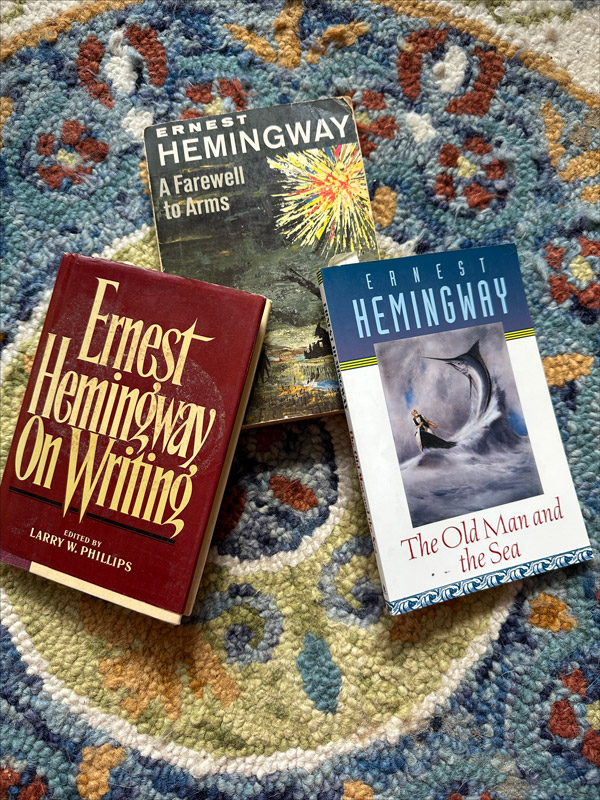
It didn’t take long for her to excitedly report that she finished it. While it was her first time to read it, it wasn’t the first time she had been transported to the Gulf Stream to witness an epic battle between marlin and old man. As she recounted in her essay written for a class the previous semester, “One of my earliest memories is my father reading to me each night from Hemingway’s The Old Man and the Sea.”
Having both a daughter and a son appreciative of one of the greatest writers ever, partly due to my bookshelf’s influence on them, is equivalent to being pinned with a rare badge of effective parenting.
Two sentences I first read 40 years ago from one of his published letters fueled my writing life: “Scott took LITERATURE so solemnly. He never understood that it was just writing as well as you can and finishing what you start.”
Delusional about my own greatness—name a writer who isn’t—I pretended that the “Scott” referenced by Papa was yours truly, and not F. Scott Fitzgerald. From the grave, Hemingway was encouraging me to write.
I return to those two sentences often while writing, like a swimmer coming up for air, though it is from the depths of a paragraph that I ultimately breach to inhale.
I read “The Old Man and the Sea” in grade school, unassigned. Countless passages made it hard to return to sixth-grade reality: “Then the fish came alive, with his death in him, and rose high out of the water showing all his great length and width and all his power and his beauty. He seemed to hang in the air above the old man in the skiff. Then he fell into the water with a crash that sent spray over the old man and over all of the skiff.”
“The Old Man and the Sea” hooked me on Hemingway.
In high school, Mrs. Kramer required us to read “The Old Man and the Sea.” With a head start on my classmates, I gladly revisited Santiago, my old Cuban friend. But Mrs. Kramer tried to ruin the book for me. As an English teacher, it was her duty to find the allegories, Christian symbolism, etc., that ruin reading for kids. Somehow, Santiago was being compared to Jesus Christ, and the sharks were compared to . . . well . . . you know.
Writing stories seemed hard enough just to write the story. To insist that a writer include hidden messages and meanings in a story seemed preposterous. Isn’t it grand enough to write, or to read, a story for the sake of the story alone?
I stood from my desk, and, to the surprise of my classmates and teacher, proclaimed,
“You don’t know how to teach.” In the principal’s office, I wisely became the great apologist, dodging a smudge on my pristine permanent record—so much for grace under pressure. Later, though, in college, by virtue of owning “Ernest Hemingway on Writing,” I came across these words by Papa: “The sea is the sea. The old man is an old man. The boy is a boy and the fish is a fish. The sharks are all sharks no better and no worse. All the symbolism that people say is shit.”
I rejoiced in Hemingway’s vindication.
This year, I touched base with a classmate, Kammy. Our last conversation was in the 1980s. She was in Mrs. Kramer’s class. Laughing on the phone, she said, “Isn’t it funny how you got C’s in her class and the rest of us got A’s and B’s, yet you’re the only one who became a writer? She didn’t like you.”
In hindsight, I like to think that Mrs. Kramer did like me, that she had singled me out for higher grading standards, applying a teacher’s tough love to help me become not only a better reader but also a better writer. When we were seniors, Mrs. Kramer and her husband, Alan, a great math teacher, actually invited a select few of us to play euchre at their house, which was a “clean, well-lighted” home built on a love for words and formulas.
I am forever indebted to Mrs. Kramer for requiring me to read “A Farewell To Arms.” I still love her for that assignment. I was excited to read a war story, but it didn’t take long to realize the novel was more of a love story than a war story. And I was OK with that. Recently, I re-read the very same copy I once flipped through in high school. Its spine is wrinkled and cracked; its pages are yellowed and pungent. All the old dog ears obediently remained in place.
It was fun to experience a book first read as a kid through adult eyes. Passages lost on me as a teen resonated more so in middle age: “I loved to take her hair down and she sat on the bed and kept very still, except suddenly she would dip down to kiss me while I was doing it, and I would take out the pins and lay them on the sheet and it would be loose and I would watch her while she kept very still and then take out the last two pins and it would all come down and she would drop her head and we would both be inside of it, and it was the feeling of inside a tent or behind a falls.”
I crave a cigarette when I re-read that passage—and I don’t even smoke.
Not long ago, to celebrate Delaney’s first short story acceptance by a literary journal, I bought “A Farewell To Arms” for her. Moved by the book, she even selected a passage from it to be read at her wedding: “At night, there was the feeling that we had come home, feeling no longer alone, waking in the night to find the other one there, and not gone away; all other things were unreal. We slept when we were tired and if we woke the other one woke too so one was not alone.”
I like to believe she chose my literary hero’s words as a nod to me, her own Papa.
I take Hemingway and his influence as a writer so solemnly. He still encourages me from the grave. To borrow the last sentence from “The Sun Also Rises”: “Isn’t it pretty to think so?”
***Subscribe for free to Scott’s Substack newsletter, called Saalmania.
