
City reconsiders alley vacation in light of lawsuit, improper notification procedures
Jasper–After the vacation of an alley in March led to a lawsuit, the Jasper Common Council is being asked to reconsider its decision since one property owner adjacent to the alley wasn’t properly notified.
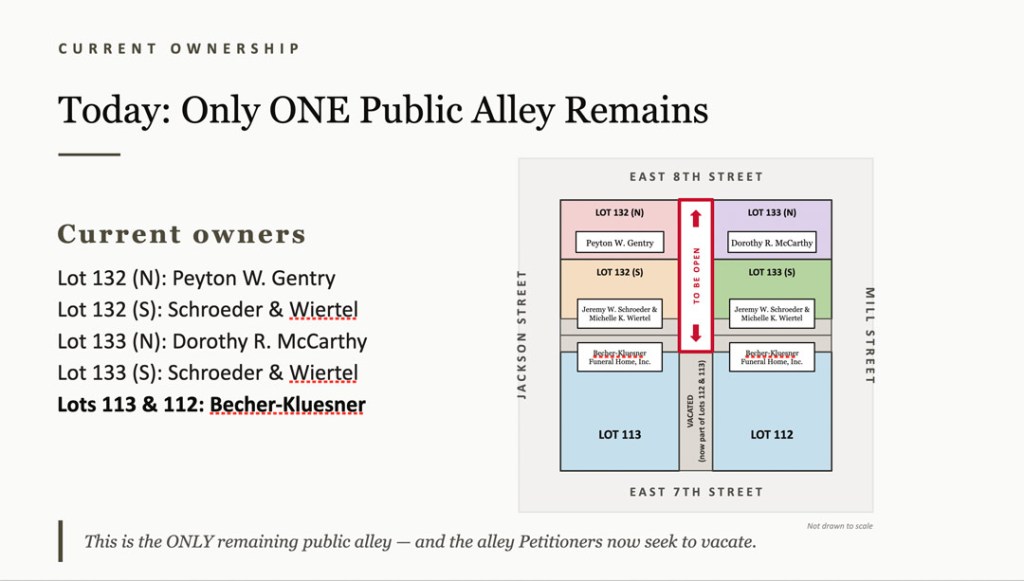
According to City Attorney Renee Kabrick, Jeremy W. Schroeder and Michelle K. Wiertel filed a petition to vacate a north-south public alley bisecting their property located between Mill and Jackson streets.
Schroeder told the council at its regular meeting on March 18, 2026, that he and Wiertel were requesting the vacation of the alley due to the disruptive traffic and the impact on access to their detached garage when cars parked in the alley.
Schroeder stated that traffic was turning into the alley from 8th Street to go to the funeral home located on East 7th Street.
“In their mind, they’re only going to be there for 20 minutes, but it prevents our entry and exit points,” Schroeder told the council in March.
He also reported that they were concerned about their personal property.
“There has been an instance where someone has actually made the turn into out drive that’s actually not public and clipped part of our deck,” he told the council, adding that they also wanted to reduce traffic through the alley as much as possible to keep their child safe.
It was approved unanimously by the council, with Councilwoman Nancy Eckerle even stating that it should have been done years ago.
Becher-Kluesner has since filed a verified complaint in Dubois County court appealing that ordinance, arguing the funeral home was never given the legally required notice as an abutting landowner and was denied the chance to object before the vote.
Becher-Kluesner’s complaint, filed April 17 — the final day of the 30-day window Indiana law allows to appeal a vacation ordinance — names not only the City of Jasper but Schroeder, Wiertel, and neighboring landowners Peyton W. Gentry and Dorothy R. McCarthy as defendants. The suit asks a judge to reverse the vacation, or alternatively to protect Becher-Kluesner’s access rights to the alley, and seeks damages and attorney’s fees.
According to Attorney Bill Kaiser, who was representing Becher-Kluesner, the funeral home had no other alternative but to file suit before the end of the 30 days after the council’s decision to appeal.
City Attorney Renee Kabrick, in a subsequent interview, said Schroeder and Wiertel have since filed a counterclaim of their own, though its specific arguments were not immediately available. Kabrick said she will not represent the city in the litigation itself; the city’s insurer has assigned outside defense counsel.
Kabrick said the original notice mistake stemmed from county property records that, at the time of the petition, appeared to show Becher-Kluesner’s land didn’t touch the remaining alley. Indiana law requires specific notice to all landowners whose property abuts a public way proposed for vacation.
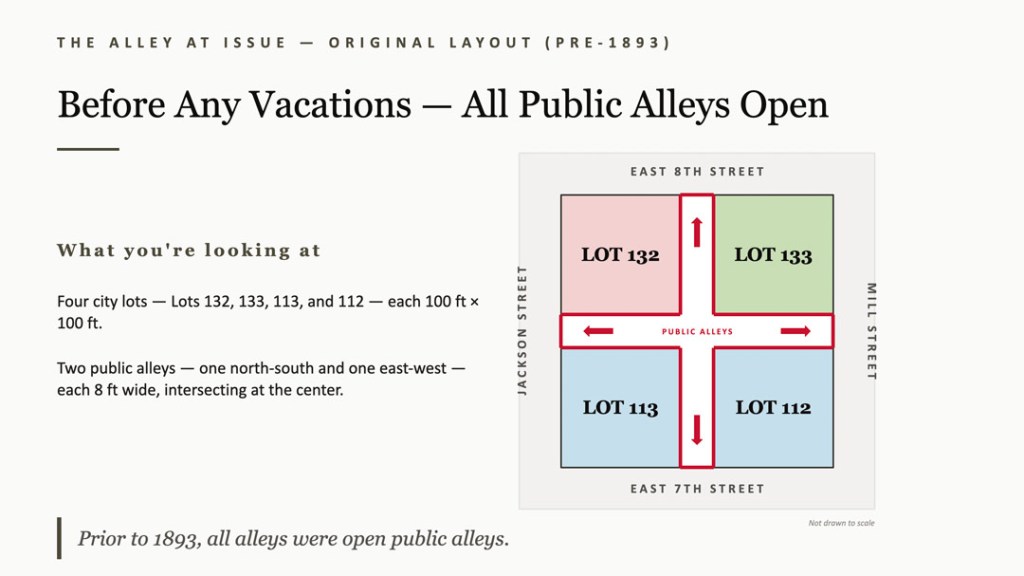
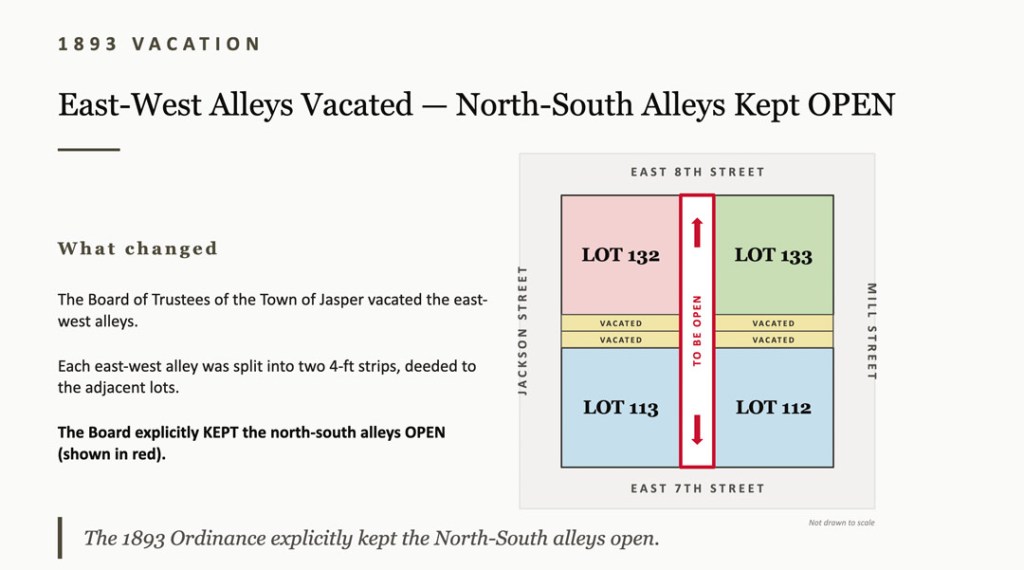
According to Becher-Kluesner’s complaint, the confusion traced back to an 1893 ordinance that vacated the east-west alley in the same block but explicitly left the north-south alley open. Because the city couldn’t find its records, they relied on county records that appeared to show the intersection where the two alleys met, and Becher-Kluesner’s abutting property line had also been vacated.
“We could not find any information concerning the vacation of the old east-west alley, except for the fact that we knew it happened because deeds going forward referenced the vacated east-west alley,” she explained.
Kabrick described how the document was eventually found while Dentons Bingham Greenebaum LLP, the law firm representing the funeral home, was conducting research for the lawsuit.
A legal aid with Dentons and the clerk-treasurer were searching the city hall’s records vault for older meeting minutes when they came across a book lying separately on a table, distinct from the shelved volumes they’d already searched.
After picking it up, they opened it to the page outlining the exact information supporting the funeral home’s claim that they should have been notified as an abutting property owner.
Once the document surfaced, the city commissioned a survey from Brosmer Land Surveying, which confirmed Becher-Kluesner’s property does abut the alley on three sides. Kabrick said that finding led her to conclude the original hearing notice was defective, and that the city should correct the error with a new notice and hearing, which is what led to Wednesday’s public hearing.
At Wednesday’s hearing, Schroeder objected to holding a rehearing at all, arguing Indiana law requires any procedural defect from the original proceeding to be resolved in court, not through a new council hearing. He said pending litigation had led his attorney to advise him to limit his comments.
“By appearing here tonight, we are not giving up our rights or objections regarding this hearing or any action taken as a result of it,” Schroeder said.
He maintained his safety concerns were unchanged from March. His original petition described a vehicle striking the couple’s house before the driver left the scene, along with repeated instances of illegally parked vehicles blocking their garage. With his wife expecting a child, Schroeder said, being able to exit their property quickly in an emergency is essential.
“We need to be able to leave our property just as much as anyone else needs to access our neighbor’s property,” Schroeder said.
Schroeder also stated the vacation didn’t meet any of the four statutory grounds for remonstrance under Indiana Code § 36-7-3-13(a) — it wouldn’t hinder development, wouldn’t make Becher-Kluesner’s access “difficult or inconvenient” given the funeral home’s multiple alternate access points (including the 1985-vacated alley section leading to its rear entrance), wouldn’t affect access to a church or school, and wouldn’t hinder use of another public way.
Schroeder argued the funeral home’s operational needs could be met through a separate portion of the alley vacated in 1985, which leads directly to the rear entrance via 7th Street, and that the canopy shown in the funeral home’s presentation sits over that already-vacated section — not the section his petition seeks to vacate.
He also noted Becher-Kluesner had waived a right of first refusal to buy the property in 2020, arguing that undercuts any claim the alley is truly indispensable to its operations.
Attorney Bill Kaiser, representing Becher-Kluesner, argued that on top of not being properly notified, the funeral home objected to the vacation since the alley’s rear entrance is critical to daily operations, not just a convenience.
“This rear entrance is the business entrance,” Kaiser told the council. “It is also the primary accessible entrance for the elderly, disabled and the mobile-limited patrons. It is also the location by which caskets, flowers, supplies — all kinds of things — are coming in the back.”
He estimated the business handles roughly three funerals a week — about 150 a year — with more than 500 visitors weekly. Kaiser added that the funeral home also serves as the county morgue, requiring round-the-clock access to the entrance accessed by the alley.
Kaiser also argued the legal standard Schroeder cited in his presentation didn’t apply to an abutting landowner like Becher-Kluesner.
Becher-Kluesner’s court filing goes further, arguing that Schroeder’s own testimony at the original March hearing undercuts the council’s finding that “no public benefit is derived” from the alley.
In an affidavit attached to the lawsuit, funeral home co-owner Joseph Kluesner describes how deliveries have worked since the alley was vacated. Vendors bringing goods to the rear of the building must now either drive up a ramp along the northeast side of the building through the alley section vacated back in 1985, then back down that same tight ramp onto East 7th Street — a busy street — to leave; or unload in the funeral home’s parking lot and carry items up the ramp by hand; or, in some cases, deliver through the funeral home’s front entrance instead.
Kluesner’s affidavit describes these workarounds as burdensome and disruptive, particularly given the funeral home’s need to keep delivery and vendor traffic separate from families arriving for services.
Following the close of public testimony, Councilman Kevin Manley said he didn’t have enough information to decide and asked for clarification on who was actually blocking access and how often.
“Something is not working now that was working for 80 years,” Manley said. “So I don’t know what that is. Who’s actually causing the problem?”
Councilwoman Nancy Eckerle raised the possibility that signage could resolve the parking issue without vacating the alley at all. Kabrick noted that if the alley remains public, enforcement of parking rules would fall to the city, as with any other public alley.
Mayor Ryan Craig recommended tabling the matter to allow more fact-gathering. Manley’s motion to table carried unanimously.
Kabrick confirmed the city has not enforced the original vacation ordinance since April, pending the rehearing — meaning the alley remains passable, though parking there is still prohibited.
Asked whether the council’s eventual decision could affect the pending lawsuit, Kabrick said if the council declines to vacate the alley, Becher-Kluesner’s core claim would likely become moot.
The counterclaim from Schroeder and Wiertel would likely still need to be resolved.
The matter is expected to return before the council at its August meeting.
