
CARES sends 5 to prevention conference
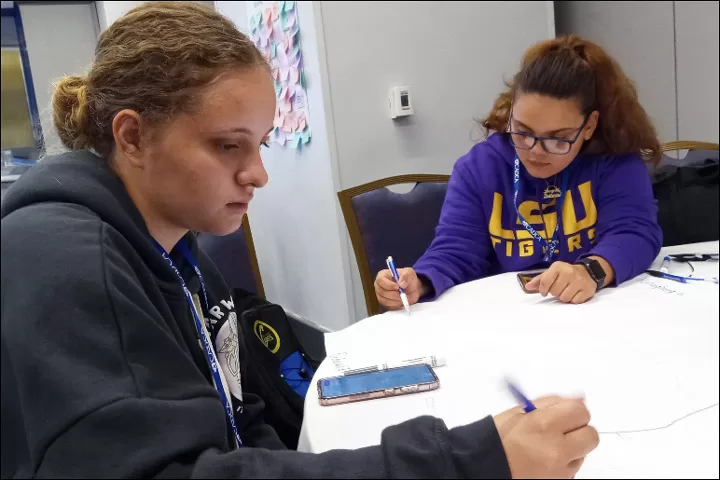
Thanks to the Dubois County Coalition for Adolescent Resilience and Empowerment Strategies, two county youth and three adults attended the annual Mid-Year Training Institute hosted July 14 to 18 by CADCA.
CADCA, CARES’ national umbrella organization, stands for Community-based, Advocacy-focused, Data-driven, Coalition-building Association. The conference drew participants from throughout the United States and internationally.
The students making the trip to Chicago were Katherine Dubon, daughter of Oscar and Dolores Dubon of Huntingburg, and Lizzi Kerkhoff, daughter of Jeff and Tarry Kerkhoff of rural Ferdinand.
The adults attending were county juvenile probation officer Melissa Neihaus and Dubois County CARES staff members Candy Neal and Martha Rasche.
While adolescents mapped their communities and learned about the key essentials of prevention work, the adults could choose from a smorgasbord of sessions about the latest developments in substance misuse prevention, new trends and data, and professional development sessions for leaders,” commented Neal, CARES director. “We got a glimpse of the latest ways to empower and support youth in the fight to reduce and stop substance misuse among their peers.”
Students had opportunities to network throughout the day and in the evenings.
Katherine, a rising senior at Southridge High school, said she enjoyed learning how to identify trouble spots for drug use and how to plan projects to improve the situation.
“I also learned that many other communities have similar issues to those in our community and different ways they’re trying to solve or reduce them. I’m excited to brainstorm some sort of event or plan to help reduce issues, such as vaping within our youth, in our community.”
Lizzi is a rising sophomore at Forest Park Junior-Senior High School. Her learning concentrated on the 7 C’s of leadership and identifying risk factors and protective factors.
“When we sat down and looked at risk factors, we looked at the ones that are in our community and there are quite a few – from gas stations that don’t card kids, smoke shops that don’t card, and even our school because kids smoke in them,” Lizzi said. “There were also protective factors like the YMCA, libraries, schools, etc. This helped me realize that there was a problem, but if kids needed help, there would be places they could go.”
Overall, she said, she learned how to be a better leader in her school and community, how to spot problems and how to work out a solution. Also, “I learned how to network and talk to people from different states and noticed that some of us have the same problem, even if they are on the other side of the nation.”
