
5Q4: Brad Ward
[box border=”full”]5Q4 is an acronym we came up with for “five questions for”, a weekly Q&A featuring local people. It might help you understand something better in the community or it just might be a fun interview of someone interesting. If you have an interesting story or know someone we might want to talk to, use our contact page to get in touch with us.[/box]
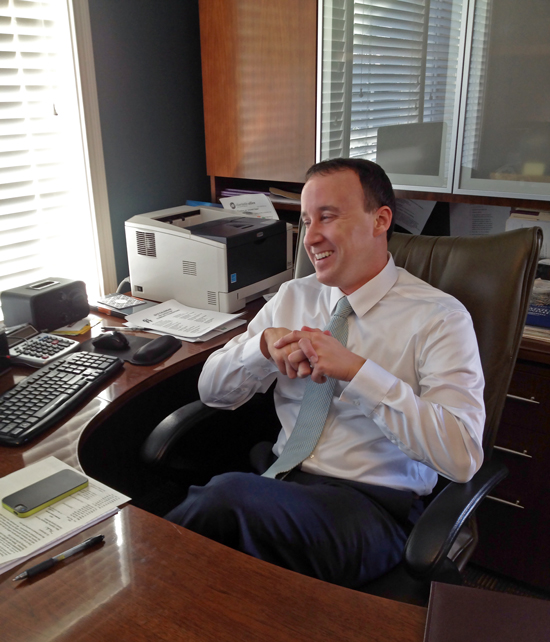
Brad Ward is the executive director of the Dubois County Community Foundation.
The 2001 graduate of Jasper High School received his Bachelor of Arts in sociology and political science from Depauw in 2005.
After working for the American Cancer Society, Ward returned to Dubois County as the director of the Huntingburg Foundation until it merged with the Dubois County Community Foundation in 2012. The newly merged foundation hired him as the executive director.
Ward has led efforts to increase the foundation’s impact in the community. This culminated in 2014 when the foundation made a $50,000 grant to support Huntingburg’s efforts to be designated a Stellar Community. Later, the foundation pledged a $100,000 matching grant to support a grassroots group intent on saving the Astra Theatre. The two grants were the largest ever made by the foundation. More details about the foundation’s successes in 2014 can be found here.
Ward and his wife Cara have a three and a half year old daughter, Finley. They live in Jasper.
When were you first introduced to volunteering and charity?
I started volunteering when I was nine years old. That was my mother’s response to me wanting to adopt a dog. I could go volunteer and have as many dogs as I want. So, I religiously volunteered every weekend, did the adoption hours and stuff like that for a number of years. That was my first introduction to a board of directors. At 12 I wasn’t overly interested in that (board) but I was curious about the business side of things.
What is the difference between the community foundation in 2012 when it merged with the Huntingburg Foundation and now?
The biggest thing is that we have shifted from being a charitable bank, or charitable trust where you deposit money and provide smaller grants that are steady and consistent, to being a bit more proactive in how endowments are part of a much larger effort.
The Astra and Stellar are great examples.
For Stellar, you are going to do four years of massive improvements to the Huntingburg community. What are you going to have to show for it in terms of building on that over the next 10, 20, 30, or 40 years? That’s where the endowment comes in and says, “hey, you have resources now”. You’ve built this massive amphitheater and beautiful Market Street plaza area, now lets have resources to spruce it up; to add in new lighting; get equipment; deal with programming; services; those kinds of things.
The Astra is the same thing. We knew community theaters were failing across the country in years two, three, four and five because there was no viable income. Whether people know it or not, you do not make a lot of money off of programs or shows. It may seem like it because you are paying a ticket price, but by the time you pay the acts and deal with the facilities, what have you actually generated in income? And that is why the Astra has sat for 12 years, no one could figure out exactly what that revenue model was going to be.
We have shifted from saying “let’s park your money here” to “let’s talk about transformational giving.” So, the conversation has shifted from raising a few hundred dollars or thousand dollars around the passing of someone we loved, or memorializing them, to what do you want your legacy to be. What values do you want to transfer to the next generation or your kids? What story do you create that is going to outlive you. That is the beauty of what we are doing today.
The foundation made $698,000 in grants in 2014. How does that compare to the past?
We’ve literally doubled it. In ’12 and ’11 we did about $354,000, then we did somewhere around $500,000 (2013) and then last year $698,000. What really is driving that is two things. We have had more giving and contributions that grow the endowments than we’ve ever had before. And, we also moved from what historically was a very conservative granting model of around two percent to three and a half percent. A whole extra one and a half percent is going out the door.
We made a ten year commitment to increasing grants by one and a half percent. It is a big commitment when we are only yielding seven percent. But it is one we feel is important.
But the real shift we made was moving away from being administratively driven to being engaged in the community. We have invested heavily in technology; almost every one of our systems is now online. We have streamlined everything so we can spend more time out in the community.
Also, we were processing 2,500 to 2,600 gifts a year and they were largely small gifts. We have tried to help people think through that when endowing a gift. Not that the small gifts don’t matter but when endowing, let’s make sure it is meaningful, it’s thoughtful and it’s thought out in regards to the difference someone wants to make. As a result, we are through the roof on a major gifts today and when we have small gifts, we encourage those gifts to go directly to the charities unless you are in the process of building up a fund.
Now we process about 1,500 gifts rather than 2,500, but we have doubled what we were doing.
We realized the sprinkle effect was counter-intuitive. If an organization asked for $700, we may have given them $100, but they may never have gotten their project off the ground. Or we would give a $400 grant that allowed them to buy copy paper. We have shifted to saying help us to understand how it is going to help you achieve something that would otherwise not be possible.
Frugality does not equal morality in philanthropy. People think the less overhead you have the better off you are. I always ask, what are you actually accomplishing.
What excites you about community foundations?
The main thing that I see is that the commercial funds have figured out that there is money to be made. There is now an encroachment of these funds on what has historically been left to community foundations. We are getting a lot of pressure to reduce our fees to operate within the mindset of a commercial fund.
A multi-billion dollar fund that has a multi-billion dollar company underwriting it (laughs) when we have $27 million in assets. We are operating on 1.5 percent and they are operating at .5 or .8 percent.
I don’t feel bad about that because the other thing they have is everything is automated, everything is electronic. Can they even pronounce the name of the principal? Probably not. Do they have any clue about what is actually transpiring? How are they connecting with others?
That is probably what is most exciting. That sounds really odd but I love the fact that we are under pressure. While some community foundations are saying they are going to be like the commercial funds, I think it gives us all the more reason to say why we are different and why we are better. We are not going to be bigger. We are going to be better at connecting people, connecting with causes, and being relationship driven.
So, what worries you?
I do worry about our ability to be in every community and to be as accessible and present at the level that is sometimes needed. The work we are doing is not fundraising. We are not raising dollars. It is a very different type of asset. We are going to build a base and we are going to live off of a stream of income from it.
I also worry about the charities that get themselves into pinches and think their endowment is a place to run. I hate when I have to tell them that it isn’t always about them in the here and now, but the reality is that the money is perpetually there and unfortunately if they mess it up, someone down the road will come around and fix it and make it better again. And that money will still be there.
St. Joseph’s Hospital had to close its doors. The money (endowment) didn’t disappear. There were many people that felt every dollar should have been spent to keep it open. For what? A few more months of activity and then the inevitable still happens. We still have resources generating income every year so we can buy defibrillators, fund suicide prevention, assist the schools with counseling, to help with the ambulance bay. We are still providing income because of that asset base when the alternative was to extend the life of the hospital a few more months.
When this community gets hit with the loss of major employers, I want to know that we have the resources to sustain the quality of life that we have that our tax dollars suddenly don’t cover. When those companies emerge or new companies take their spots, I want to ensure we are just as vibrant and just as strong as we were before the failure occurred.
